

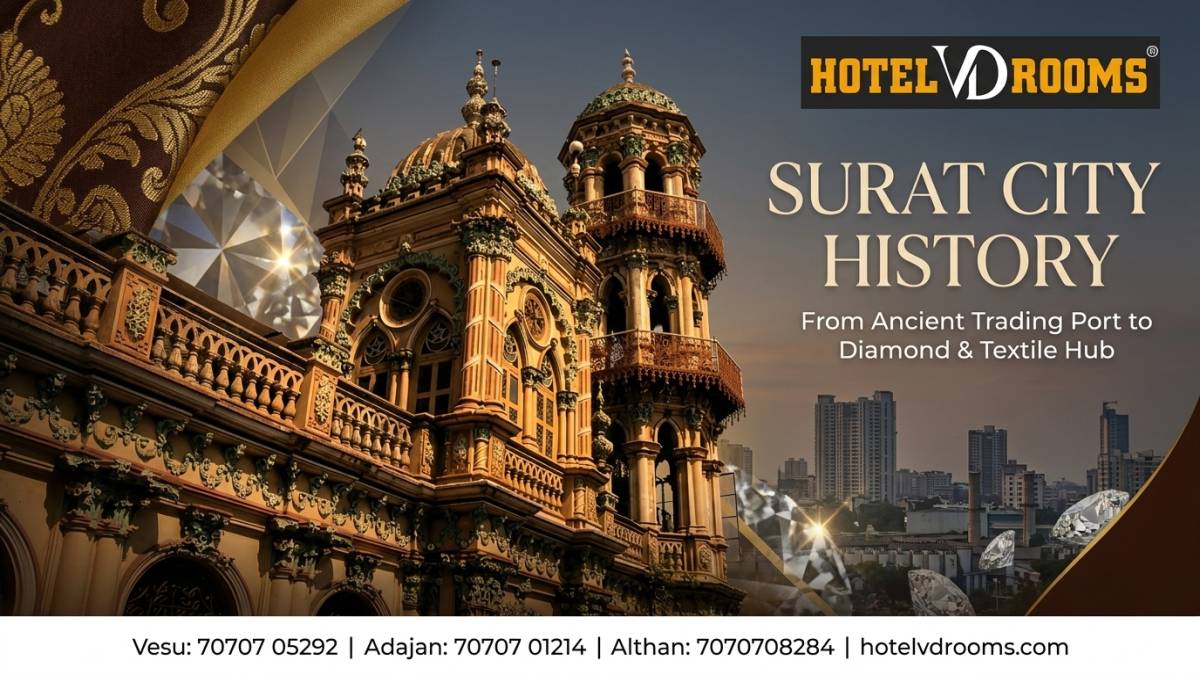
Surat City History: From Ancient Trading Port to Gujarat’s Modern Diamond & Textile Hub
Surat city history is a fascinating journey through centuries of trade, culture, migration, industry and transformation. Located on the banks of the Tapi River in Gujarat, Surat has evolved from an important maritime trading centre into one of India’s most prominent diamond and textile hubs.
The city’s history stretches back to ancient times, while its major growth as a commercial centre took place through the medieval and early modern periods. Surat became an important link between India and overseas markets, attracting merchants and trading communities from different parts of the world. Today, that entrepreneurial spirit continues through its textile manufacturing, diamond cutting and polishing, trade, zari work and other industries.
According to the Surat Municipal Corporation, the city’s history dates back to around 300 BC, while the development of the old Hindu town of Suryapur is associated with the 1500–1520 AD period. Its position along the Tapi River and its access to the Arabian Sea helped Surat become a major centre of sea trade during the 16th, 17th and 18th centuries.
For travelers, understanding Surat city history adds another dimension to exploring its forts, old markets, religious monuments, riverfront areas and textile districts. And after a day of discovering the city, a comfortable stay at Hotel VD Rooms can make your Surat experience even more convenient.
Surat City History: How Surat Began and Developed
The earliest chapters of Surat city history reach far beyond the modern city that visitors see today. Its location beside the Tapi River played a major role in shaping its development.
Surat City History and the Origins of Suryapur
Surat Municipal Corporation records that the city's history dates to approximately 300 BC. The origin of the modern settlement is also connected with an old Hindu town known as Suryapur, associated with the period between 1500 and 1520 AD.
Over time, Surat developed into an important settlement because of its geographical advantages.
The Tapi River provided access toward the coast, while the city's position near the Arabian Sea made it suitable for commerce and maritime activity.
This geographical combination would eventually transform Surat into one of the most important ports on India's western coast.
Surat City History and the Importance of the Tapi River
The Tapi River has always been closely connected with Surat's identity.
The city developed around the river, and its relationship with the waterway helped facilitate trade and transportation. Surat Municipal Corporation notes that the city is situated on the Tapi and has a coastal belt along the Arabian Sea.
Even today, visitors can see how important the river remains to Surat by exploring its riverfront areas and nearby neighborhoods.
Surat City History: Surat as a Major Maritime Trading Port
One of the most important chapters in Surat city history began when the city emerged as a major maritime trading centre.
Surat City History and the Rise of Overseas Trade
During the 16th, 17th and 18th centuries, Surat enjoyed considerable prosperity through sea trade. According to the Surat Municipal Corporation, the city became an important trade link between India and other countries.
Merchants came to Surat to trade a wide range of products, and the city's port became an important gateway for international commerce.
The District Surat administration describes Surat as a historic port where ships associated with more than 84 countries anchored in its harbour at its height.
This international character helped shape the city's culture.
Surat City History and International Trading Communities
Surat attracted traders and communities from different parts of the world, including the British, Dutch, Portuguese and Armenians.
The District Surat heritage portal notes the presence of European trading communities and preserved remnants such as the British and Dutch cemeteries and Armenian churchyard.
This multicultural history remains visible today through Surat's architecture, heritage monuments and historic neighborhoods.
Surat City History: The British, Dutch and Portuguese Connection
European traders played an important role in Surat city history, particularly during the period when Surat was one of India's leading ports.
Surat City History and the British East India Company
The British established a trading centre known as the Kothi in Surat in 1612. The Surat Municipal Corporation also records that Sir Thomas Roe visited Surat in 1614 and obtained trading rights for the East India Company through negotiations with Emperor Jahangir.
These developments demonstrate how strategically important Surat had become to international commerce.
For the British, access to Surat meant access to India's western trade networks.
Surat City History and Dutch Trading Influence
The Dutch also established commercial operations in Surat.
The legacy of these communities can still be explored through historic cemeteries and monuments. The District Surat heritage information identifies the Dutch and British cemeteries and the Armenian churchyard as important remnants of the city's international trading past.
For history enthusiasts, these locations provide an opportunity to see a side of Surat that goes beyond its modern commercial identity.
Surat City History and the Portuguese Presence
The Portuguese were also part of Surat's broader international trading history. The District Surat administration notes that the Portuguese, Dutch and British established business centres in Surat, leaving historical remnants behind.
This international influence is one of the reasons Surat's heritage is so diverse.
Surat City History: The Mughal Era and Surat's Fortifications
The Mughal period is another important part of Surat city history.
Surat City History and Surat Fort
Surat Fort is one of the city's most significant historical monuments.
According to Surat Municipal Corporation, an early fortification existed during the Tughlaq period in 1372 CE, while a more substantial fort was constructed in 1546 under Khudavand Khan during the Gujarat Sultanate. The fort later came under Mughal, Siddi and British control during different periods.
The fort's architecture reflects the changing political history of Surat.
It is therefore more than just an old building—it is a physical record of the different powers that influenced the city.
Surat City History and Mughal Sarai
Another fascinating monument is Mughal Sarai.
Surat Municipal Corporation explains that the building was constructed in 1644 during the reign of Mughal Emperor Shah Jahan and originally served as a sarai, or travelers' inn.
The building demonstrates how important Surat was as a destination for travelers and pilgrims.
Today, Mughal Sarai is also connected with Surat's municipal administration, making it a remarkable example of historic architecture continuing to have a modern role.
Surat City History: The Decline of the Old Port
The prosperity of Surat's historic port did not continue indefinitely.
Surat City History and the Rise of Bombay Port
As Bombay's port grew in importance, Surat's position in international maritime trade gradually declined.
Surat Municipal Corporation states that the rise of Bombay's port during the 17th and 18th centuries dealt a significant blow to Surat's earlier maritime prosperity, including its shipbuilding industry.
The city's economy therefore had to evolve.
This ability to adapt would become one of the defining characteristics of modern Surat.
Surat City History and the Changing Economy
Although Surat's maritime importance declined, its commercial spirit did not disappear.
The city gradually developed new economic strengths, particularly in textiles, manufacturing and trade.
This transition eventually laid the foundation for the Surat that exists today.
Surat City History: From Traditional Trade to Textile Powerhouse
The transformation of Surat's economy is one of the most interesting aspects of Surat city history.
Surat City History and the Growth of Textiles
Surat became increasingly associated with textile manufacturing and trading.
The District Surat heritage portal notes that the city's textile markets contain a wide range of saris, salwar kameez, dress materials, polyester, silk, printed and embroidered fabrics.
Today, visitors can experience this textile culture by exploring Surat's famous textile markets.
The markets are not simply shopping destinations—they represent a major part of the city's economic and cultural identity.
Surat City History and Zari Work
Zari embroidery and decorative textile work have also contributed to Surat's reputation.
Traditional skills combined with large-scale manufacturing helped Surat establish itself as a major textile centre.
The city's textile ecosystem now serves customers and businesses across India and international markets.
Surat City History: How Surat Became a Diamond Hub
Perhaps the biggest transformation in modern Surat city history has been the rise of the diamond industry.
Surat City History and Diamond Cutting
Surat is internationally recognized for diamond cutting and polishing.
The Surat Municipal Corporation identifies diamond cutting and polishing as one of the key pillars of the city's economy alongside textile manufacturing, trade, zari work, chemicals and petrochemical industries.
The scale of this industry has made Surat one of the world's most important diamond-processing centres.
Surat City History and the Modern Diamond Economy
The city's diamond industry has created a vast network of skilled workers, traders, businesses and supporting industries.
This modern economic ecosystem has transformed Surat's skyline, infrastructure and employment landscape.
The city's evolution from a historic port to a global diamond-processing centre shows how Surat has repeatedly reinvented itself.
Surat City History: Surat's Textile and Diamond Identity Today
Modern Surat is often associated with two major industries: diamonds and textiles.
Surat City History and Surat's Textile Industry
The textile industry remains one of the defining features of the city's economy.
Surat Municipal Corporation identifies textile manufacturing, trade, diamond cutting and polishing, zari work, chemical industries and petrochemical and natural gas-based industries among the major contributors to Surat's economy.
For visitors, this means Surat offers a unique opportunity to combine business tourism with shopping and cultural exploration.
Surat City History and the City's Industrial Growth
Post-independence industrial growth significantly expanded Surat.
According to Surat Municipal Corporation, the city experienced substantial growth in industrial and trading activities after independence, accompanied by residential development and an expansion of the city's boundaries.
That expansion continues to shape modern Surat.
Surat City History: Heritage Places Every Traveler Should Explore
Learning about Surat city history becomes much more interesting when you visit the places where that history actually happened.
Surat City History Through Surat Fort
Surat Fort should be high on the list for anyone interested in the city's past.
Its layers of Tughlaq, Gujarat Sultanate, Mughal, Dutch and British influences reflect the changing political and commercial environment of Surat over centuries.
Surat City History Through Mughal Sarai
Mughal Sarai offers another perspective on the city's role as a destination for travelers.
Its original purpose as a travelers' inn highlights how people were moving through Surat centuries ago for trade, pilgrimage and other purposes.
Surat City History Through the Old Textile Markets
Surat's textile markets provide a connection between its historic trading culture and its modern economic identity.
Walking through the markets gives visitors a chance to see the city's commercial energy firsthand.
The District Surat heritage portal specifically highlights the textile markets as an important part of the city's identity.
Surat City History: Food, Culture and Everyday Life
The story of Surat city history is not limited to forts and ports. It can also be experienced through food and everyday culture.
Surat City History and Surati Food Culture
Surat's food culture reflects the city's diverse population and long history of trade and migration.
Popular local foods include locho, khaman, khamni, ghari and a variety of Gujarati snacks.
The District Surat administration also highlights roadside food as an important part of the city's culture.
For travelers, trying local food is one of the easiest ways to experience modern Surat.
Surat City History and a Multicultural Identity
Centuries of interaction between local communities and international traders contributed to Surat's diverse cultural character.
The city's heritage includes Hindu, Islamic, European and Parsi influences, among others.
This diversity continues to be reflected in Surat's architecture, cuisine, festivals and neighborhoods.
Surat City History: Best Areas to Stay While Exploring Surat
If you want to explore Surat city history, your accommodation can make your trip much easier.
Surat City History Exploration from Vesu
Vesu is a modern and well-connected part of Surat.
Hotel VD Rooms offers a Vesu branch suited to travelers looking for access to contemporary shopping, dining and business areas. The hotel's own travel content highlights Vesu's connectivity to destinations such as Surat Airport and Dumas Beach.
You can explore the Hotel VD Rooms Vesu stay options before planning your heritage itinerary.
Surat City History Exploration from Adajan
Adajan provides another convenient base for travelers exploring Surat.
Hotel VD Rooms' Adajan-focused content highlights the area's access to attractions, food and shopping, making it suitable for both leisure and business travelers.
For visitors who want to explore the western side of the city while maintaining a comfortable base, Adajan can be a practical choice.
Surat City History Exploration from Althan
Althan is another growing area of Surat with modern infrastructure and commercial connectivity.
Hotel VD Rooms' Althan information highlights its access to Vesu, Bhimrad, Piplod and Adajan, making it useful for travelers whose plans include multiple parts of the city.
Surat City History: Why Hotel VD Rooms Is a Convenient Base
Exploring Surat city history can involve long days of walking, sightseeing, shopping and food exploration. A comfortable room gives you the chance to relax and recharge.
Surat City History Trips and Comfortable Rooms
Hotel VD Rooms provides multiple room categories designed for different types of travelers. Its website features room options and booking information for guests planning stays in Surat.
Depending on your requirements, you can choose a practical room for a short business trip or a more premium option for a relaxed leisure stay.
You can explore the available Hotel VD Rooms options directly.
Surat City History Trips for Business Travelers
Surat attracts business travelers because of its textile, diamond and industrial ecosystem.
If your trip combines business meetings with heritage sightseeing, staying in a conveniently located hotel can save valuable travel time.
Hotel VD Rooms has branches in Vesu, Adajan and Althan, allowing travelers to select a location based on their itinerary.
Surat City History: A Suggested Heritage and Culture Itinerary
If you are visiting Surat specifically to understand its history, you can create an itinerary that combines heritage, food and modern industry.
Surat City History Day One: Forts and Old Surat
Start your first day with Surat Fort.
Spend time exploring its architecture and learning about the different periods represented in its construction and restoration.
Continue toward Mughal Sarai and other historic areas.
Later, explore the old markets and enjoy traditional Surati food.
Surat City History Day Two: Trade, Textiles and Modern Surat
Use the second day to explore Surat's textile markets.
Observe the range of fabrics, embroidery and dress materials that demonstrate the city's modern commercial identity.
You can then explore contemporary Surat, including its modern business districts, shopping destinations and newer neighborhoods.
This combination gives you a clear picture of how Surat moved from a historic trading port to a modern commercial powerhouse.
Surat City History: Why the City Continues to Evolve
The most remarkable lesson from Surat city history is the city's ability to adapt.
Surat City History and Economic Reinvention
Surat's economy has changed dramatically over the centuries.
It once depended heavily on maritime trade. When its port declined in importance, the city developed new strengths in textiles and manufacturing. Later, the diamond industry became another major pillar of its economy.
Today, Surat has a diverse economic base that includes textiles, diamonds, trade, chemicals, petrochemicals and other industries.
Surat City History and Modern Urban Development
Surat continues to expand as businesses, workers and families move to the city.
The Surat Municipal Corporation describes Surat as one of India's dynamic cities, with rapid development driven by industrial activity and migration from Gujarat and other parts of India.
This means the history of Surat is still being written.
The modern city you see today is another chapter in a story that has already lasted for centuries.
Surat City History: Final Thoughts
Surat city history is much more than a timeline of rulers, ports and industries. It is the story of a city that repeatedly adapted to changing circumstances.
From its early development along the Tapi River to its rise as a major maritime trading centre, Surat attracted merchants and communities from across the world. The Mughal period, European trading presence, decline of the old port, growth of textiles and rise of the diamond industry each added another layer to its identity.
Today, Surat stands proudly as a major diamond and textile hub while preserving reminders of its remarkable past through places such as Surat Fort, Mughal Sarai, historic cemeteries, old markets and religious monuments.
For travelers, exploring Surat city history is an opportunity to see both sides of the city—the historic Surat that grew through international trade and the modern Surat powered by diamonds, textiles, technology and entrepreneurship.
And when you need a comfortable place to return to after exploring the city, Hotel VD Rooms offers stay options across Vesu, Adajan and Althan.
Plan your Surat trip, explore its heritage, experience its famous food and discover how centuries of trade and innovation shaped one of Gujarat's most dynamic cities.
Useful Resources for Exploring Surat
-
Surat Municipal Corporation – History — Official historical overview of Surat.
-
District Surat – Culture & Heritage — Heritage, textile markets and cultural information.
-
Surat Municipal Corporation – Surat Fort — Historical information about Surat Fort.
-
Hotel VD Rooms — Explore accommodation options for your Surat visit.